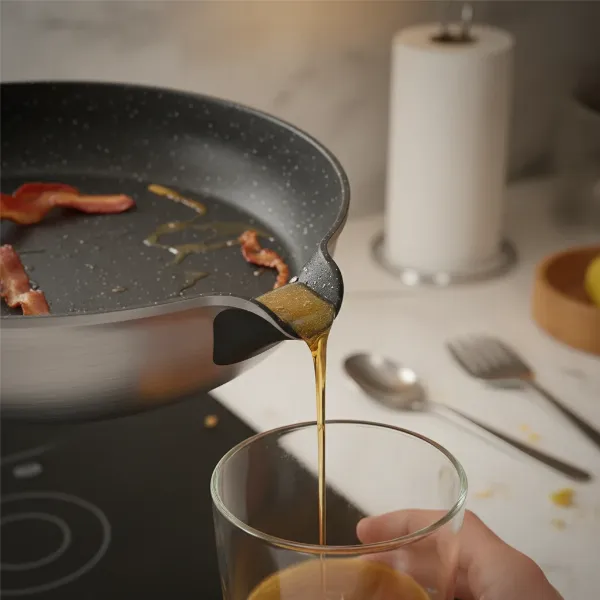
An electric skillet can be a kitchen game-changer, offering versatile cooking capabilities from frying and sautéing to stewing and simmering. But to truly unlock its potential and protect its often delicate non-stick surface, you need the right tools. Have you ever experienced a spatula melting into your perfectly cooked dish or scratching the coating of your beloved skillet? Choosing the best heat-resistant spatulas is crucial for safe, efficient, and enjoyable cooking with your electric skillet, ensuring longevity for both your cookware and utensils. This guide will walk you through everything you need to know, from understanding different spatula materials to selecting the ideal tool for every culinary task.
What is an Electric Skillet?
An electric skillet is a versatile countertop appliance that functions as a self-contained frying pan with its own heating element and thermostat. Unlike traditional stovetop pans, it offers precise temperature control and even heat distribution, making it ideal for a wide range of cooking methods, from gently warming food to deep-frying. Its history dates back to the mid-20th century, evolving from basic heating elements to sophisticated models with advanced coatings and features.
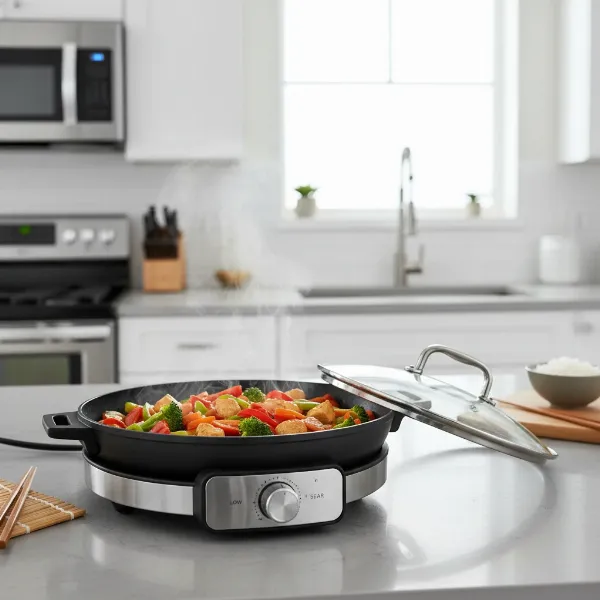 Modern electric skillet cooking a meal on a kitchen countertop, showcasing its precise temperature control.
Advantages and Disadvantages of Electric Skillets
Electric skillets bring undeniable convenience to the kitchen, but like any appliance, they come with their own set of pros and cons. Understanding these can help you appreciate why certain cooking tools, especially heat-resistant spatulas, are indispensable.
Advantages
Electric skillets offer several compelling benefits that make them a favorite among home cooks.
- Flexibility and Convenience: These appliances are incredibly versatile, allowing you to cook a wide array of dishes, from breakfast to dinner, often directly at the dining table or buffet. Their portability means you can cook anywhere with an outlet, freeing up stovetop space for other tasks.
- Precise Temperature Control: Most electric skillets feature an adjustable thermostat, enabling you to maintain a consistent cooking temperature for optimal results. This precision is difficult to achieve with stovetop burners, which often fluctuate in heat output.
- Space-Saving: For those with limited kitchen space or dormitory living, an electric skillet can consolidate several cooking functions into one compact appliance. It can replace a frying pan, slow cooker, and even a small oven for certain recipes.
- Easy to Clean: Many modern electric skillets feature non-stick surfaces and removable, dishwasher-safe components, simplifying the cleanup process after a meal. This ease of maintenance is a significant advantage over scrubbing baked-on food from traditional pans.
|
Our Picks for the Best Electric skillet in 2026
As an Amazon Associate I earn from qualifying purchases.
|
||
| Num | Product | Action |
|---|---|---|
| 1 | Elite Gourmet EG6201 Extra Deep 12"x12"x3.2" (7.5Qt.) Scratch Resistant Dishwasher Safe, Non-stick Electric Skillet with Glass Vented Lid, Adjustable Temperature, Black |

|
| 2 | Elite Gourmet 12"x12"x2.15” Ceralast™ PFAS Free Ceramic Electric Skillet, Dishwasher Safe, Rapid Heat Up, 1200W, Dark Grey |
|
| 3 | Elite Gourmet EG808 8” x 8" Non-stick Electric Skillet, Dishwasher Safe with Tempered Glass Vented Lid, Rapid Heat Up, 600W, Black |
|
| 4 | Elite Gourmet EG-6203# Extra Deep 16"x13"x3.2" (10.5Qt.) Scratch Resistant, Easy Pour Spout Dishwasher Safe, Non-stick Electric Skillet with Glass Vented Lid, Adjustable Temperature, Black |
|
| 5 | Blue Diamond 7QT 5-in-1 Extra Large Electric Skillet, Healthy Ceramic Nonstick Interior, Non-Toxic PFAS-Free, Temperature Control, Stay Cool Handles, Easy Clean, Graphite |
|
| 6 | Pioneer Woman 3.5L Electric Skillet, Linen Speckle |
|
| 7 | Nuwave Medley XL Digital Electric Skillet, Family Size Griddle w/Glass Lid, 2025 New & Improved Precision Heating, 100°-425°F, PFAS Free G11 Nonstick Ceramic Coating, Portable Hot Plate, 7qt Capacity |
|
| 8 | bella Make & Take Electric Skillet, Fits-anywhere™ kitchenware, EverGood™ Ceramic Coating, Adjustable Temperature & Dishwasher-Safe Tempered Glass Lid, Cast Aluminum Base, 1200 Watt, Oatmilk |
|
| 9 | Presto 06857 16-inch Electric Foldaway Skillet, Black |
|
| 10 | FOHERE 16-Inch Electric Skillet with Glass Cover, 1500W Rapid Heat, Adjustable Temperature, Multi-Purpose Electric Skillet Fried Chicken, Perfect For Family Gathering Cooking |
|
Disadvantages
Despite their benefits, electric skillets also have certain limitations to consider.
- Limited Portability: While portable in the sense that they can be moved, electric skillets require an electrical outlet, which can limit their use in outdoor settings or areas without power access. Their bulk can also make them less convenient to transport than a simple frying pan.
- Power Requirement: Operating an electric skillet means consuming electricity, which might be a consideration for energy-conscious users or during power outages. It’s a dedicated appliance that adds to your electrical load.
- Not Suitable for All Cooking Methods: While versatile, electric skillets are not ideal for all culinary techniques. For instance, high-heat searing that demands extreme temperatures or specialized tasks like wok cooking might be better suited for a stovetop burner or a dedicated appliance.
Types of Heat-Resistant Spatulas: Materials and Their Benefits
When cooking with an electric skillet, particularly those with non-stick coatings, the material of your spatula is paramount. It determines not only its heat resistance but also its ability to protect your cookware from damage.
Silicone Spatulas
Silicone spatulas are widely regarded as the top choice for electric skillets, especially those with non-stick surfaces. This material is exceptionally heat-resistant, with many models tolerating temperatures up to 600°F (315°C), far exceeding typical cooking temperatures. Silicone is also incredibly flexible and soft, ensuring it won’t scratch or damage the non-stick coating of your skillet, making it a safe bet for prolonged use. They are excellent for scraping bowls clean, stirring, flipping delicate foods like eggs, and can often be safely placed in the dishwasher for easy cleaning. [cite: 1, 2, 5 (search 1); 1, 2, 3, 4, 5 (search 2); 1, 2, 3, 5 (search 3); 1, 2, 4, 5 (search 4)]
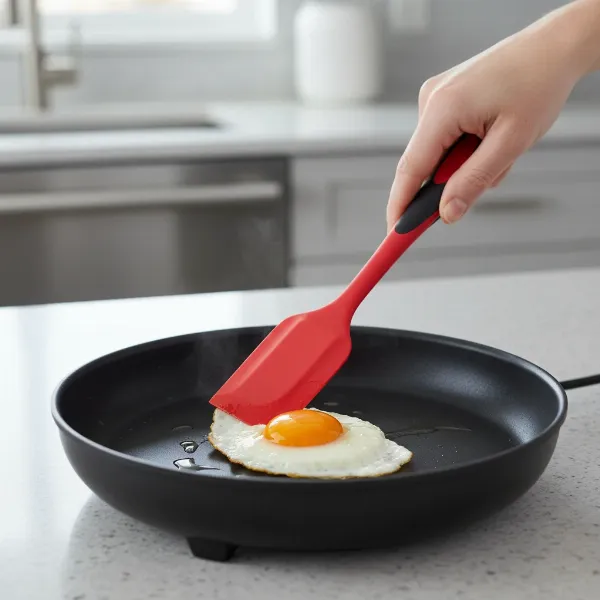 Hand using a red silicone spatula to gently flip eggs in a non-stick electric skillet, protecting the surface.
Nylon Spatulas
Nylon spatulas offer good heat resistance, typically handling temperatures up to 400-450°F (204-232°C). They are a more affordable alternative to silicone and are generally safe for non-stick cookware due to their relatively soft nature. However, it’s important to note that nylon can soften or even melt if left resting in a very hot pan for an extended period. Some nylon spatulas are designed with a slightly more rigid edge, which can be useful for scraping fond (browned bits) from the bottom of pans, particularly in deglazing, but this rigidity also means less flexibility than silicone. [cite: 2, 3, 4 (search 3); 2, 4, 5 (search 4)]
Wooden Spatulas
Wooden spatulas are a classic choice favored for their natural aesthetic and gentle touch on all types of cookware, including non-stick and cast iron electric skillets. They are naturally heat-resistant and won’t scratch surfaces. Hardwoods like beech or bamboo are preferred for their durability and less porous nature, which helps resist absorbing odors and bacteria. However, wood is less flexible than silicone, and while heat-resistant, it can char or crack over time if exposed to extreme heat or if not properly maintained. Wooden spatulas require hand washing and proper drying to prevent warping, cracking, or bacterial growth. [cite: 2 (search 2); 1, 2, 3 (search 4)]
Stainless Steel Spatulas
Stainless steel spatulas are incredibly durable and highly heat-resistant, making them ideal for high-heat cooking and heavy-duty tasks. They excel at smashing burgers or chopping ground meat. However, their hard edges can easily scratch the non-stick coating of most electric skillets. Therefore, stainless steel spatulas are best reserved for electric skillets with more robust surfaces, such as cast iron or ceramic, or for specific tasks where precision and rigidity are paramount and non-stick damage is not a concern. [cite: 4 (search 1); 1 (search 2); 2 (search 3); 4, 5 (search 4)]
Key Factors When Choosing the Best Heat-Resistant Spatula for Electric Skillets (Buying Guide)
Selecting the perfect spatula goes beyond just picking one off the shelf. Several critical factors influence its performance, longevity, and suitability for your electric skillet.
Material and Heat Resistance
The material dictates both the maximum temperature the spatula can withstand and its impact on your skillet’s surface. For non-stick electric skillets, silicone is generally the best choice due to its superior heat resistance (often up to 600°F) and scratch-proof properties. Nylon is a good secondary option, while wooden spatulas are excellent for gentle use. Avoid metal spatulas on non-stick surfaces to prevent damage. [cite: 1, 2, 3 (search 3); 1, 2, 4 (search 4)]
Flexibility and Edge Design
Consider the tasks you’ll perform. A flexible, thin-edged spatula, typical of silicone turners, is ideal for sliding under delicate foods like eggs or pancakes without breaking them. A firmer edge, sometimes found in nylon spatulas, might be better for scraping or lifting heavier items. The edge design should allow for easy maneuvering in your skillet. [cite: 1 (search 2)]
Handle Comfort and Length
A comfortable, ergonomic handle ensures a secure grip, reducing hand fatigue during longer cooking sessions. The handle material should also be heat-resistant, as you might inadvertently rest it on the edge of a hot skillet. Look for handles that provide good balance and a length appropriate for the depth of your electric skillet, keeping your hands safely away from the heat. Spatulas with seamless silicone construction (head and handle) are often preferred for hygiene and heat resistance. [cite: 4 (search 2); 4 (search 3)]
Non-Stick Compatibility
This is paramount for electric skillets with non-stick coatings. Silicone and wooden spatulas are universally safe, while nylon is generally safe but can degrade with excessive heat exposure. Metal spatulas should only be used with cast iron or other non-coated electric skillets to avoid scratching the surface. Always verify the spatula’s compatibility with non-stick cookware before purchase. [cite: 1, 2, 3 (search 2); 3 (search 3)]
Ease of Cleaning
A spatula that’s easy to clean is a joy to use. Silicone spatulas are often dishwasher-safe and non-porous, preventing food particles and odors from sticking. Nylon spatulas are also typically dishwasher-safe. Wooden spatulas, however, usually require hand washing and thorough drying to maintain their integrity and prevent bacterial growth. Consider your cleaning preferences when making a choice.
Top Brands and Recommended Heat-Resistant Spatulas
When it comes to reliable and high-performing heat-resistant spatulas, several brands consistently receive praise from home cooks and culinary experts. Investing in quality tools from these manufacturers ensures durability and efficiency in your kitchen.
| Brand | Material | Key Features | Max Temp (Approx.) | Pros | Cons |
|---|---|---|---|---|---|
| OXO | Silicone | Angled edge, comfortable handle, seamless design | 600°F (315°C) | Excellent for scraping, durable, dishwasher-safe | Can feel too large for very small pans |
| ThermoWorks | Silicone | Sturdy, high-temp resistance, comfortable grip | 600°F (315°C) | Strong, easy to clean, ideal for flipping | Primarily focused on turners |
| GIR (Get It Right) | Silicone | Ultimate Spatula line, precise flexibility | 550°F (288°C) | Innovative design, thin edges, great for eggs/pancakes | Higher price point |
| Tovolo | Silicone, Wood | Wide range of designs (turners, scrapers, spoonulas) | 600°F (315°C) | Good balance of flexibility/rigidity, versatile | Some silicone models are heavier |
| Sur La Table | Silicone/Nylon | Often feature silicone heads with nylon cores | 500-600°F (260-315°C) | Good blend of flexibility and firmness | Specific models vary in heat resistance |
“For non-stick cookware, always reach for silicone. It offers the best combination of high-heat resistance and a gentle touch, preserving your skillet’s surface for years.” – Chef Maria Sanchez, Culinary Instructor
Tips for Using and Maintaining Your Heat-Resistant Spatula
Proper use and care extend the life of your spatulas and ensure optimal performance with your electric skillet.
Usage Tips
Getting the most out of your heat-resistant spatulas involves understanding their strengths and how to handle them correctly.
- First-Time Use: Before using any new spatula, especially silicone or nylon, wash it thoroughly with warm, soapy water to remove any manufacturing residues. This ensures it’s clean and ready for food contact.
- Match Spatula to Task: Use flexible silicone spatulas for delicate tasks like flipping eggs or scraping batter. For stirring thicker foods or breaking up ground meat (if using a non-stick safe material), a slightly firmer nylon or a robust silicone turner is appropriate. Wooden spatulas are excellent for general stirring and sautéing.
- Adjust Temperature Appropriately: While heat-resistant, avoid leaving any spatula, especially nylon, resting in a hot electric skillet for extended periods. Even silicone, while durable, can degrade over time with constant, extreme heat exposure. Use your electric skillet’s temperature control to prevent overheating.
- Use Proper Cooking Utensils: Pair your heat-resistant spatulas with other non-abrasive tools to protect your skillet’s surface. Avoid sharp metal utensils that can scratch or gouge.
Cleaning and Storage
Effective cleaning and mindful storage are key to the longevity and hygiene of your spatulas.
- Clean After Each Use: Wash your spatulas immediately after use to prevent food from drying on them, which makes cleaning harder. Most silicone and nylon spatulas are dishwasher-safe, but always check manufacturer instructions. Wooden spatulas should be hand washed with mild soap and warm water, then dried thoroughly to prevent warping or cracking.
- Avoid Abrasive Cleaners: For all spatula materials, steer clear of abrasive scrubbers or harsh chemical cleaners, as these can damage the surface of the spatula, especially silicone or nylon.
- Store Correctly: Store spatulas in a clean, dry place, such as a utensil crock or a drawer, to prevent cross-contamination and prolong their life. Ensure wooden spatulas are completely dry before storing to inhibit mold or mildew growth.
Conclusion
Choosing the right heat-resistant spatula is a small but significant step in enhancing your electric skillet cooking experience and preserving your investment. By prioritizing materials like high-quality silicone and understanding the specific needs of your non-stick surfaces, you equip yourself with tools that perform safely and efficiently. Whether you’re flipping pancakes, sautéing vegetables, or gently stirring a stew, the right spatula makes all the difference. Embrace the versatility of your electric skillet with the confidence that your utensils are up to the task. What will be the first delicious meal you create with your perfectly paired electric skillet and heat-resistant spatula?
Frequently Asked Questions
Can I use metal spatulas on all electric skillets?
No, metal spatulas are generally not recommended for electric skillets with non-stick coatings as they can easily scratch and damage the surface. They are best suited for cast iron or stainless steel electric skillets that can withstand abrasive tools.
What is the maximum temperature a silicone spatula can withstand?
Most high-quality food-grade silicone spatulas are heat-resistant up to 500°F to 600°F (260°C to 315°C). This makes them incredibly safe for nearly all cooking applications on an electric skillet, far exceeding typical cooking temperatures.
Are wooden spatulas truly heat-resistant for an electric skillet?
Wooden spatulas are naturally heat-resistant and will not melt, but they can char or burn if exposed to very high direct heat for too long. They are safe for non-stick surfaces and are excellent for general stirring and sautéing at moderate temperatures.
Why do my nylon spatulas sometimes melt in my electric skillet?
Nylon spatulas have a lower heat tolerance than silicone, typically melting around 400-450°F (204-232°C). Leaving them in a hot electric skillet or using them at very high temperatures can cause them to soften, warp, or even melt, affecting both the spatula and potentially your food.
How do I prevent my spatulas from scratching my non-stick electric skillet?
To prevent scratching, always opt for spatulas made from soft, non-abrasive materials like silicone or wood. Avoid metal utensils unless your electric skillet explicitly states it’s safe for metal, which is rare for non-stick coated models.