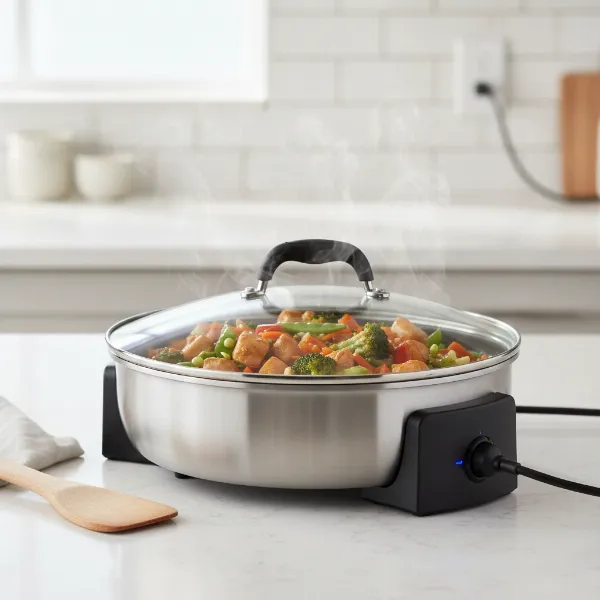
An electric skillet is a culinary workhorse, renowned for its versatility and precise temperature control. But when your trusty appliance starts acting up, often due to a faulty temperature controller cord, it can bring your cooking to a halt. As someone who has spent over a decade deeply immersed in the world of electric skillets, I understand the frustration a broken cord can cause. While the thought of “DIY repair” might seem daunting, accurately diagnosing the issue and understanding your options can often save you from prematurely replacing your entire skillet.
This comprehensive guide will walk you through the common problems associated with electric skillet temperature controller cords, help you assess whether a DIY fix is feasible and safe, provide step-by-step instructions for diagnosis, and explore the best solutions, from straightforward replacements to understanding when it’s time to invest in a new appliance. Prioritizing safety, we’ll empower you with the knowledge to bring your electric skillet back to life.
What is an Electric Skillet Temperature Controller Cord?
At its heart, an electric skillet’s temperature controller cord is more than just a power cable; it’s the brain behind your appliance’s precise cooking. This detachable unit typically includes a probe that inserts into the skillet’s heating element receptacle and a dial or digital interface for setting the desired temperature. Its primary function is to regulate the heat output of the skillet, ensuring consistent temperatures for frying, simmering, or roasting.
The cord contains a thermostat mechanism that senses the skillet’s internal temperature. When the temperature drops below your set point, it sends power to the heating element; when it rises above, it cuts the power. This on-off cycling maintains a steady heat, preventing scorching and ensuring evenly cooked meals. Understanding this crucial role highlights why a malfunctioning controller cord can render your entire skillet unusable.
Common Problems with Electric Skillet Temperature Controller Cords
The temperature controller cord, being a frequently handled component, is susceptible to wear and tear over time. Recognizing the symptoms of a failing cord is the first step toward a solution.
- Intermittent Heating or No Heat: This is the most common sign. Your skillet might heat inconsistently, get too hot, or not heat at all, even when plugged in and turned on. This often points to a faulty thermostat within the controller or a break in the internal wiring.
- Visible Damage to the Cord: Fraying, cuts, kinks, or exposed wires on the external cord indicate physical damage that can interrupt electrical flow and pose a serious safety risk.
- Loose Connection: The plug that connects to the skillet might feel wobbly or lose its grip, leading to power interruptions. Similarly, the wall plug could be damaged.
- Failure to Turn On/Indicator Light Off: If your skillet receives no power and the indicator light on the controller doesn’t illuminate, it could be a complete break in the circuit within the cord or controller.
- Smell of Burning Plastic or Electrical Odor: This is an immediate warning sign of overheating or a short circuit within the cord or controller. Discontinue use immediately.
These issues often arise from repeated bending, improper storage (wrapping the cord too tightly), accidental damage, or simply the aging of internal components.
Is DIY Repair Right for You? Safety First!
Before attempting any repair, it is crucial to address safety. Working with electrical appliances carries inherent risks, including electrical shock and fire hazards, if proper precautions are not followed.
“Safety is paramount when dealing with any electrical appliance. If you’re not confident in your electrical repair skills, it’s always best to seek professional help or consider a replacement to avoid potential hazards.” – Electric Skillet Guide Admin, Electric Skillet Expert
Prioritize your safety with these essential guidelines:
- Always Unplug: Before inspecting or attempting any repair, always ensure the electric skillet is unplugged from the wall outlet.
- Wear Protective Gear: Use insulated work gloves, safety goggles, and rubber-soled shoes to minimize the risk of electrical shock and protect against sharp edges or debris.
- Use Insulated Tools: Only use tools with insulated handles when working near electrical components.
- Work in a Dry Environment: Ensure your work area is dry and well-lit. Avoid working on wet surfaces or in damp conditions.
- Never Bypass Safety Features: Do not attempt to bypass thermal cut-offs or other safety mechanisms, as they are designed to prevent overheating and fires.
- Assess Your Comfort Level: If you are uncomfortable or unsure about any step, do not proceed. Electrical repairs can be complex, and it’s better to err on the side of caution.
For simple cord replacements, the risks are minimal if you follow instructions carefully. However, internal repairs to the thermostat mechanism are more advanced and generally not recommended for the average DIYer.
Diagnosing Your Electric Skillet Temperature Controller Cord
Pinpointing the exact fault in your temperature controller cord often requires a basic tool: a multimeter. This device can test for “continuity,” determining if there’s an unbroken electrical path through the cord.
Tools You’ll Need:
- Multimeter (with continuity setting)
- Screwdriver (if disassembly of the controller housing is needed, though often not for initial tests)
Step-by-Step Diagnosis:
- Unplug the Skillet: Absolutely ensure the skillet is disconnected from power.
- Set Your Multimeter: Turn your multimeter to the continuity setting (often indicated by a speaker icon or a diode symbol).
- Test the Multimeter: Touch the two probes of the multimeter together. A healthy multimeter will typically beep and display a reading of zero or close to zero ohms, indicating a continuous circuit. If it doesn’t, check the battery or refer to your multimeter’s manual.
- Test the Power Cord (from Wall Plug to Controller Pins):
- Locate the prongs on the wall plug end of the cord.
- Identify the corresponding metal pins on the end of the cord that plugs into the skillet (inside the plastic housing).
- Place one multimeter probe on one prong of the wall plug.
- Place the other probe on one of the metal pins inside the skillet-side connector.
- You are essentially tracing one wire. Repeat this for all wire paths (typically two or three, depending on if it’s a grounded cord).
- A beep and a zero-ohm reading indicate continuity. No beep or an “OL” (open loop) reading means there’s a break in that specific wire path within the cord.
- Test the Thermostat (if accessible):
- If you’ve confirmed continuity in the wires but suspect the thermostat, and if the controller housing can be safely opened (consult your skillet’s manual or look for screws), you can test the thermostat directly.
- With the multimeter still on the continuity setting, place probes on the two terminals of the thermostat inside the controller.
- Turn the temperature dial from off to its highest setting. You should hear a click and get a continuity reading (beep/low ohms) when the thermostat closes the circuit. If you get no continuity at any setting, the thermostat is likely faulty.
- Inspect for Visible Damage: Even after testing, visually inspect the entire length of the cord for kinks, cuts, or burn marks. Pay close attention to where the cord enters the wall plug and the controller housing.
If your multimeter indicates an open circuit, or you find clear visible damage, your temperature controller cord is likely the culprit.
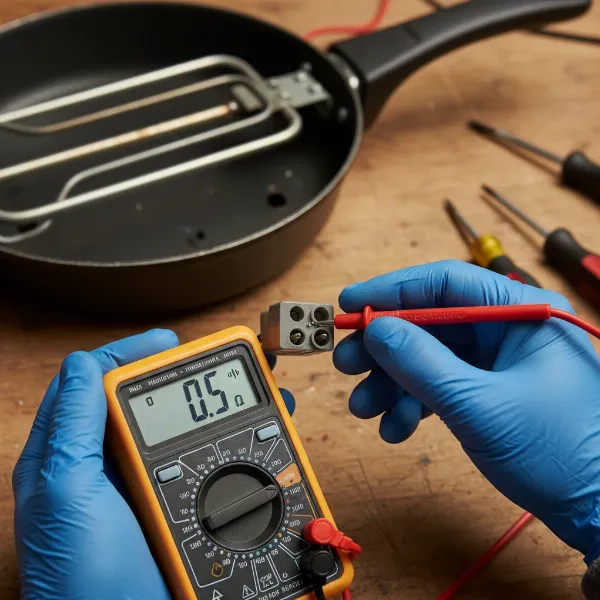 Person using a multimeter to test an electric skillet temperature control cord for continuity
Options for Fixing or Replacing a Broken Temperature Controller Cord
Once you’ve diagnosed a faulty temperature controller cord, you have several avenues to explore.
Option 1: Replacing the Entire Cord Assembly
For most electric skillet users, the safest and most effective “DIY fix” is to replace the entire detachable temperature controller cord assembly. These units are often proprietary to specific brands or models, but many are interchangeable across various electric skillets.
How to Find a Compatible Replacement:
- Check Your Old Cord: Examine your existing cord for a brand name, model number, or any specifications (voltage, amperage, plug type).
- Consult Your Skillet Manual: Your skillet’s user manual might list compatible replacement parts or contact information for the manufacturer.
- Online Retailers: Websites like Amazon, eBay, and specialized appliance parts stores (e.g., Fix.com) are excellent resources. Search using your skillet’s brand and model number, or directly for “electric skillet replacement temperature control cord.”
- Appliance Repair Stores: Local appliance repair shops often stock common replacement cords or can order one for you. They might also offer advice on compatibility.
- Match Specifications: Crucially, ensure the replacement cord matches the original in terms of:
- Plug Type: The shape and pin configuration that connects to your skillet.
- Voltage and Amperage: These ratings must match your skillet’s requirements to prevent overheating or underperformance. Electric skillets operate at high wattages (1,200W-1,800W), so a generic power cord won’t suffice. [cite: 3 of ‘Replace electric skillet detachable cord’]
- Wire Gauge: A compatible cord will have the correct wire thickness to handle the sustained current draw.
Our Picks for the Best Electric skillet in 2026As an Amazon Associate I earn from qualifying purchases.Num Product Action 1 Elite Gourmet EG6201 Extra Deep 12"x12"x3.2" (7.5Qt.) Scratch Resistant Dishwasher Safe, Non-stick Electric Skillet with Glass Vented Lid, Adjustable Temperature, Black 
2 Nuwave Medley XL Digital Electric Skillet, Family Size Griddle w/Glass Lid, 2025 New & Improved Precision Heating, 100°-425°F, PFAS Free G11 Nonstick Ceramic Coating, Portable Hot Plate, 7qt Capacity
3 Blue Diamond 7QT 5-in-1 Extra Large Electric Skillet, Healthy Ceramic Nonstick Interior, Non-Toxic PFAS-Free, Temperature Control, Stay Cool Handles, Easy Clean, Graphite
4 Pioneer Woman 3.5L Electric Skillet, Linen Speckle
5 Elite Gourmet EG-6203# Extra Deep 16"x13"x3.2" (10.5Qt.) Scratch Resistant, Easy Pour Spout Dishwasher Safe, Non-stick Electric Skillet with Glass Vented Lid, Adjustable Temperature, Black
6 Elite Gourmet EG808 8” x 8" Non-stick Electric Skillet, Dishwasher Safe with Tempered Glass Vented Lid, Rapid Heat Up, 600W, Black
7 FOHERE 16-Inch Electric Skillet with Glass Cover, 1500W Rapid Heat, Adjustable Temperature, Multi-Purpose Electric Skillet Fried Chicken, Perfect For Family Gathering Cooking
8 Elite Gourmet 12"x12"x2.15” Ceralast™ PFAS Free Ceramic Electric Skillet, Dishwasher Safe, Rapid Heat Up, 1200W, Dark Grey
9 bella Make & Take Electric Skillet, Fits-anywhere™ kitchenware, EverGood™ Ceramic Coating, Adjustable Temperature & Dishwasher-Safe Tempered Glass Lid, Cast Aluminum Base, 1200 Watt, Oatmilk
10 Presto 06857 16-inch Electric Foldaway Skillet, Black
The Replacement Process:
Replacing the cord assembly is typically straightforward: simply remove the old cord by unplugging it from the skillet and the wall, then insert the new, compatible cord. No tools are usually required for this step. [cite: 1 of ‘Replace electric skillet detachable cord’]
Option 2: Repairing the Cord’s Plug End (If Applicable and Safe)
If the damage is limited to the wall plug end of a standard power cord (not the specialized thermostat end) and the rest of the cord is intact, you might be able to replace just the plug. However, most electric skillet controller cords are sealed units, and this repair is less common or recommended for the thermostat-integrated end. If the damage is to the main power plug that connects to the outlet, and you are electrically competent, this may be an option.
Tools Needed:
- Wire strippers
- Screwdriver
- New replacement plug (matching original specifications)
- Utility knife (optional)
Basic Steps (Use extreme caution and only if you understand electrical wiring):
- Cut the Damaged Plug: Carefully cut off the damaged plug, ensuring you leave enough cord length for the new plug.
- Strip the Wires: Use wire strippers to expose the insulated wires (typically black/hot, white/neutral, green/ground).
- Attach New Plug: Follow the instructions provided with your new replacement plug to properly connect the wires to the correct terminals (hot to brass, neutral to silver, ground to green screw). Ensure all connections are secure and there are no stray wire strands.
- Test: Before plugging into the skillet, use a multimeter to ensure continuity and check for any short circuits.
Important Note: This type of repair is more common for basic appliances with generic power cords. For the sophisticated temperature controller cord of an electric skillet, a full assembly replacement (Option 1) is almost always the safer and more reliable choice.
Option 3: Internal Controller Repair (Advanced & Not Recommended for Most)
Attempting to repair the internal components of an electric skillet temperature controller – such as replacing a thermal fuse or mending internal wiring – is a complex task. It often requires specialized tools like a soldering iron, a deep understanding of electronics, and the ability to work with high-voltage components safely. [cite: 5 of ‘How to fix electric skillet temperature controller cord’]
Why it’s generally not recommended for the average user:
- High Risk: The intricate nature of these repairs increases the risk of electrical shock or creating a fire hazard if done incorrectly.
- Compromised Safety Features: Tampering with internal components can inadvertently bypass critical safety mechanisms, leading to dangerous malfunctions.
- Difficulty Sourcing Parts: Finding individual internal components (like specific thermostats or thermal fuses) for an electric skillet controller can be challenging.
- Cost-Effectiveness: The time, effort, and potential cost of specialized tools and parts often outweigh the cost of a new replacement cord or even a new skillet.
Unless you possess certified electrical repair expertise and are aware of the specific dangers involved, it is strongly advised to avoid internal repairs of the temperature controller.
When to Consider a New Electric Skillet
While fixing a broken temperature controller cord can be a satisfying and cost-effective solution, there are times when purchasing a new electric skillet makes more sense.
- Cost of Repair vs. Replacement: If a new replacement cord is expensive (approaching half the cost of a new skillet), or if the skillet itself is old and showing other signs of wear, a new purchase might be more economical in the long run.
- Non-Availability of Parts: For older or less common models, finding a compatible replacement cord can be difficult or impossible. In such cases, buying a new skillet is the practical choice.
- Extensive Damage: If your skillet has other major issues, such as a damaged non-stick coating, a faulty heating element (which is typically not repairable), or structural damage, replacing the cord alone won’t solve the underlying problems.
- Safety Concerns: If you are at all uncomfortable with the repair process or worry about the safety of a repaired appliance, investing in a new unit offers peace of mind.
Modern electric skillets often come with enhanced features, improved durability, and better energy efficiency, making an upgrade a worthwhile consideration.
Maintenance Tips to Prevent Cord Damage
A little preventative care can significantly extend the life of your electric skillet’s temperature controller cord.
- Proper Storage: Avoid tightly wrapping the cord around the skillet or controller. Instead, loosely coil the cord and secure it with a cable tie or velcro strap. Store the cord where it won’t be kinked or crushed.
- Gentle Handling: Always grasp the plug itself when pulling the cord from the wall outlet or the skillet. Never yank the cord, as this can strain the internal wiring and connections.
- Regular Inspection: Periodically check the cord for any signs of damage, such as fraying, cuts, or discolored areas. If you spot damage, address it immediately.
- Keep Clean and Dry: Ensure the connection points on both the skillet and the controller cord are clean and dry before plugging in. Moisture can lead to electrical issues.
- Avoid Overheating the Cord: Ensure the cord doesn’t come into contact with hot surfaces of the skillet during operation or storage.
By implementing these simple maintenance practices, you can significantly reduce the likelihood of needing to fix or replace your temperature controller cord in the future.
Conclusion
A broken temperature controller cord doesn’t necessarily spell the end for your beloved electric skillet. By understanding the function of this critical component, accurately diagnosing the problem with a continuity test, and choosing the appropriate solution – most often, a direct replacement of the cord assembly – you can restore your appliance to full working order. While internal repairs are generally best left to professionals, responsible DIY can be a rewarding endeavor. Always prioritize safety, match replacement parts meticulously, and consider when a new skillet might be the more practical and secure investment. With the right approach, you can keep your electric skillet cooking for many more years to come.
What’s your go-to dish for celebrating a successful electric skillet repair?
Frequently Asked Questions
How do I know if my electric skillet temperature control cord is bad?
Common signs include inconsistent heating, the skillet not turning on, visible cord damage like fraying or cuts, or a burning smell. A multimeter can confirm an internal break by testing for continuity; if there’s no continuous electrical path, the cord is faulty.
Can I use any power cord for my electric skillet?
No, you cannot use just any power cord. Electric skillet temperature controller cords are specialized, designed to handle high wattages (1200-1800W) and often feature proprietary plug types and internal thermostats. Using a generic cord can be a fire hazard and damage your appliance.
Is it expensive to replace an electric skillet temperature control cord?
The cost varies depending on the brand and model, but replacement cords are generally affordable, typically ranging from $15-$40. This is significantly less expensive than replacing the entire electric skillet, making it a cost-effective repair.
Where can I buy a replacement temperature control cord?
You can find replacement cords on major online retailers like Amazon, eBay, and specialized appliance parts websites such as Fix.com. It’s also worth checking with local appliance repair stores or directly with the manufacturer of your electric skillet.