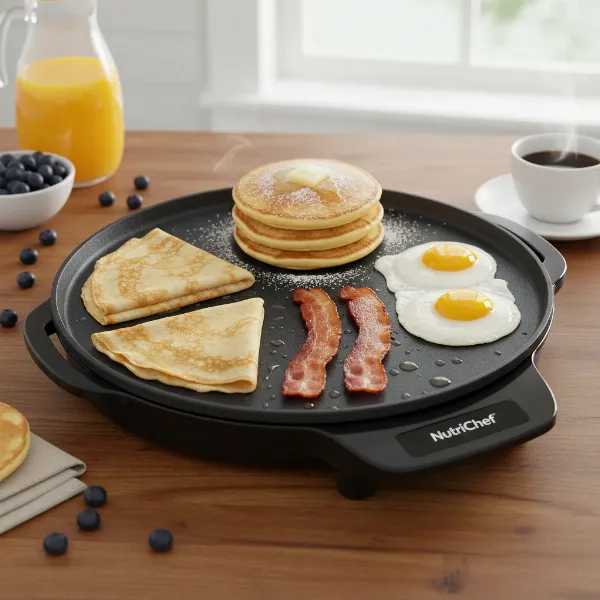
In the bustling heart of any kitchen, the performance of your cookware is paramount. Few features inspire more confidence—and sometimes confusion—than a robust non-stick surface. As culinary technology advances, two contenders often rise to the top when it comes to durability and resilience: titanium and diamond coatings. But when pitting titanium vs. diamond coating head-to-head, which truly offers the superior strength and longevity for your everyday cooking demands? Understanding the nuances of these advanced materials is key to making an informed choice that will serve your kitchen for years to come.
Understanding Non-Stick Coatings
Non-stick coatings revolutionize cooking by creating a surface that prevents food from adhering, making cleanup effortless. Historically, these coatings often relied on polytetraetrafluoroethylene (PTFE), commonly known as Teflon. While highly effective, concerns over durability and chemical compounds like PFOA (now largely phased out) have driven innovation towards safer and stronger alternatives. This is where reinforcement comes into play. Manufacturers now embed harder materials into the non-stick matrix to boost its resistance against scratches, abrasion, and general wear and tear, significantly extending the lifespan and performance of your favorite pans and pots.
Titanium Coatings: The Steel Beneath the Surface
Titanium has earned its reputation across industries for exceptional strength-to-weight ratio and resistance to corrosion. In cookware, titanium is harnessed in several ways to enhance durability.
What is Titanium Coating?
|
Our Picks for the Best Electric skillet in 2026
As an Amazon Associate I earn from qualifying purchases.
|
||
| Num | Product | Action |
|---|---|---|
| 1 | Blue Diamond 7QT 5-in-1 Extra Large Electric Skillet, Healthy Ceramic Nonstick Interior, Non-Toxic PFAS-Free, Temperature Control, Stay Cool Handles, Easy Clean, Graphite |

|
| 2 | Nuwave Medley XL Digital Electric Skillet, Family Size Griddle w/Glass Lid, 2025 New & Improved Precision Heating, 100°-425°F, PFAS Free G11 Nonstick Ceramic Coating, Portable Hot Plate, 7qt Capacity |
|
| 3 | Elite Gourmet 12"x12"x2.15” Ceralast™ PFAS Free Ceramic Electric Skillet, Dishwasher Safe, Rapid Heat Up, 1200W, Dark Grey |
|
| 4 | FOHERE 16-Inch Electric Skillet with Glass Cover, 1500W Rapid Heat, Adjustable Temperature, Multi-Purpose Electric Skillet Fried Chicken, Perfect For Family Gathering Cooking |
|
| 5 | Elite Gourmet EG6201 Extra Deep 12"x12"x3.2" (7.5Qt.) Scratch Resistant Dishwasher Safe, Non-stick Electric Skillet with Glass Vented Lid, Adjustable Temperature, Black |
|
| 6 | Presto 06857 16-inch Electric Foldaway Skillet, Black |
|
| 7 | Elite Gourmet EG-6203# Extra Deep 16"x13"x3.2" (10.5Qt.) Scratch Resistant, Easy Pour Spout Dishwasher Safe, Non-stick Electric Skillet with Glass Vented Lid, Adjustable Temperature, Black |
|
| 8 | bella Make & Take Electric Skillet, Fits-anywhere™ kitchenware, EverGood™ Ceramic Coating, Adjustable Temperature & Dishwasher-Safe Tempered Glass Lid, Cast Aluminum Base, 1200 Watt, Oatmilk |
|
| 9 | Pioneer Woman 3.5L Electric Skillet, Linen Speckle |
|
| 10 | Elite Gourmet EG808 8” x 8" Non-stick Electric Skillet, Dishwasher Safe with Tempered Glass Vented Lid, Rapid Heat Up, 600W, Black |
|
When we talk about titanium coating in cookware, we’re usually referring to one of two primary applications. First, there’s pure titanium cookware, which is made entirely of titanium or a titanium alloy. This type is known for being incredibly lightweight and non-reactive, making it popular for camping gear. However, pure titanium can have poor heat conductivity and food tends to stick to it without a separate non-stick layer. More commonly, “titanium coating” refers to a non-stick layer (often a PTFE or ceramic base) that has been reinforced with titanium particles. These tiny titanium particles are integrated into the non-stick material during the manufacturing process, acting as a structural enhancer that fortifies the surface against damage.
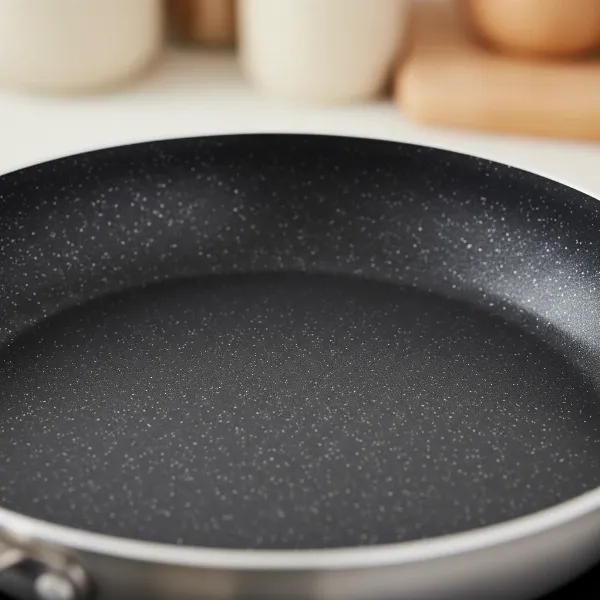 Close-up of a non-stick frying pan with visible titanium reinforcement in the coating.
Advantages of Titanium Reinforcement
Cookware with titanium-reinforced non-stick coatings offers a compelling array of benefits that appeal to home cooks and professionals alike. The addition of titanium significantly boosts the coating’s durability, making it far more resistant to the everyday scrapes and scratches that can quickly degrade standard non-stick surfaces. This enhancement means your pans retain their non-stick properties for longer, resisting chipping and peeling even with regular use. Furthermore, titanium itself is remarkably lightweight, making titanium-reinforced pans easier to handle and maneuver, a considerable advantage during busy cooking sessions. Its non-reactive nature also ensures that it won’t leach chemicals into your food, contributing to a healthier cooking experience.
Limitations of Titanium Coatings
While titanium reinforcement brings substantial improvements, it’s not without its limitations. Despite the added hardness, titanium-reinforced non-stick coatings are not indestructible and can still be scratched or damaged by metal utensils if not used carefully. The primary non-stick layer, even when reinforced, can eventually wear down, leading to reduced non-stick performance over time. For cookware made of pure titanium, the material’s inherent poor heat conductivity often necessitates a multi-ply construction with other metals like aluminum or copper to achieve even heat distribution, which can add to the pan’s weight and cost. Moreover, pure titanium surfaces, while durable, are not naturally non-stick and typically require seasoning or a separate non-stick coating.
Diamond Coatings: Unparalleled Hardness
Diamonds are the hardest known natural material on Earth, making them an intriguing choice for enhancing cookware durability. Their properties translate directly into formidable strength when applied as a coating.
What is Diamond Coating?
Diamond coatings in cookware utilize the incredible hardness of diamonds to create exceptionally resilient non-stick surfaces. There are generally two forms this takes: diamond-infused coatings and vacuum-brazed diamond coatings. Diamond-infused coatings incorporate tiny diamond particles directly into a non-stick base layer, often ceramic or a PTFE blend. These microscopic diamonds act as super-hard fillers, dramatically improving the coating’s scratch and abrasion resistance. A more advanced and premium option is vacuum-brazed diamond cookware, where actual diamond crystals are permanently bonded directly to the metal surface in a vacuum environment, sometimes using a specialized titanium alloy as a bonding agent. These higher-end coatings are celebrated for being exceptionally durable and resistant to chipping or peeling. Many modern diamond coatings are also marketed as PFAS-free, offering a health-conscious alternative to traditional non-stick.
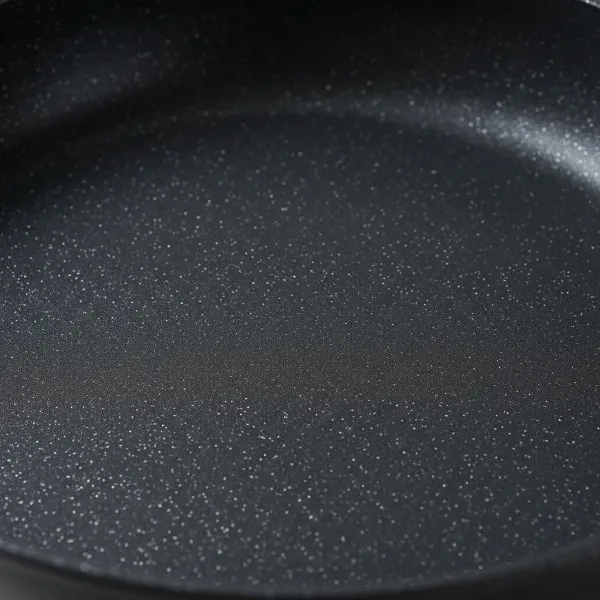 Macro view of a non-stick pan's surface, highlighted with infused diamond particles for enhanced durability.
Advantages of Diamond Reinforcement
The integration of diamonds into cookware coatings offers a range of compelling benefits, primarily centered around their extraordinary hardness. Diamond-reinforced coatings provide extreme scratch resistance, far surpassing many other non-stick options. This means they are less likely to degrade from the everyday wear of cooking utensils, extending the effective lifespan of the pan. Beyond durability, diamonds are excellent conductors of heat. When incorporated into a coating, they can help distribute heat more evenly across the cooking surface, reducing hot spots and leading to more consistent cooking results. This superior heat distribution can also contribute to quicker heating times and more efficient energy use. Furthermore, many diamond coatings are entirely PFAS-free, addressing health concerns associated with older non-stick technologies, making them a safer choice for many consumers.
Limitations of Diamond Coatings
Despite their superior hardness and performance, diamond coatings do come with certain limitations. The most significant factor is often the cost; cookware featuring genuine diamond-bonded or heavily diamond-infused coatings tends to be more expensive than other non-stick options. There can also be variations in quality; some “diamond-infused” coatings might contain only a minimal amount of diamond particles, offering less benefit than premium versions with a higher concentration or those using the vacuum-brazed method. While incredibly hard, even diamond coatings are not immune to damage from extreme misuse, such as prolonged high heat exposure or very sharp metal utensils, which can eventually compromise the underlying non-stick properties if the coating is damaged.
Direct Comparison: Titanium vs. Diamond Coating Strength
When faced with choosing between titanium and diamond-reinforced non-stick coatings, a direct comparison of their key attributes helps clarify which might be superior for specific needs. Both aim to improve durability, but they achieve this with differing levels of performance.
Durability and Scratch Resistance: Diamond coatings, particularly those with actual diamond crystals bonded to the surface, generally offer superior hardness and scratch resistance. Diamonds are naturally the hardest material, giving them an edge against abrasion. Titanium-reinforced coatings are very durable and a significant upgrade from basic non-stick, but they may eventually show signs of wear under heavy use more quickly than high-quality diamond coatings.
Heat Distribution: Diamond particles are excellent thermal conductors, which helps create very even heat distribution across the pan surface, minimizing hot spots. While titanium-reinforced coatings rely more on the core material for heat distribution, they often perform well. Pure titanium cookware, however, struggles with even heat distribution on its own.
Non-Stick Performance: Both types of coatings are designed to provide excellent non-stick properties. The primary difference lies in the longevity of that non-stick performance. A more durable surface, such as a high-quality diamond coating, is likely to maintain its non-stick effectiveness for a longer period because the underlying non-stick layer is better protected from damage.
Safety: Both titanium-reinforced and diamond-coated cookware are generally considered safe for cooking, especially modern versions that are PFOA-free. Many diamond coatings actively promote their PFAS-free status, appealing to consumers seeking chemical-free options. Titanium is a non-reactive metal, ensuring it doesn’t interact with food.
Cost: Titanium-reinforced non-stick cookware tends to be more accessible in terms of price, offering a good balance of performance and value. Diamond-coated cookware, especially premium variants with true diamond bonding, often comes with a higher price tag, reflecting the advanced technology and superior material properties.
Here’s a summary comparing these two advanced non-stick options:
| Feature | Titanium Coating (Reinforced Non-Stick) | Diamond Coating (Reinforced Non-Stick) |
|---|---|---|
| Primary Reinforcement | Titanium particles mixed into non-stick layer (PTFE/ceramic) | Diamond particles infused or actual diamonds bonded to surface |
| Hardness/Strength | Very good; significantly improves scratch/abrasion resistance | Excellent to Superior; extreme hardness, highly scratch-resistant |
| Heat Distribution | Good (depends on base metal); pure titanium is poor | Excellent; diamonds are superb thermal conductors |
| Non-Stick Longevity | Long-lasting, but may eventually show wear with heavy use | Very long-lasting; surface protected from degradation |
| Safety | Generally safe; PFOA-free in modern versions, non-reactive | Generally safe; often promoted as PFAS-free |
| Cost | Mid-range to High-end (more accessible than premium diamond) | High-end to Premium (especially vacuum-brazed diamond) |
| Weight | Often lightweight | Typically lightweight (coating doesn’t add significant mass) |
“While titanium offers a fantastic balance of durability and value, the sheer hardness of diamond coatings often gives them an edge in preventing microscopic wear, which translates to a longer-lasting non-stick surface, especially for those who cook daily.”
Choosing the Right Coating for Your Kitchen
Deciding between titanium and diamond-coated cookware comes down to your individual priorities, cooking habits, and budget. Both represent significant advancements in non-stick technology, offering durability far beyond traditional options.
Your Cooking Style and Frequency
Consider how often you cook and the types of dishes you prepare. If you’re an avid home chef who uses non-stick pans daily and values the absolute maximum in scratch resistance and longevity, a high-quality diamond-coated pan might be the ideal investment. Its superior hardness can withstand more rigorous use. For those who cook regularly but perhaps aren’t subjecting their pans to constant, high-intensity use, titanium-reinforced cookware offers an excellent balance of durability and performance that will satisfy most culinary needs. If delicate foods and even browning are your priority, the superior heat distribution of diamond coatings could be a deciding factor.
Budget Considerations
Cost is often a significant factor. Titanium-reinforced non-stick cookware typically offers a more accessible entry point into high-durability non-stick options, providing excellent value for its enhanced performance. On the other hand, premium diamond-coated cookware, particularly those featuring advanced bonding technologies, will generally be a more substantial investment. However, for some, the extended lifespan and potentially superior performance of diamond coatings may justify the higher initial outlay, making it a cost-effective choice in the long run by reducing the frequency of pan replacement.
Health and Environmental Factors
For health-conscious consumers, the composition of non-stick coatings is a critical concern. Both titanium and modern diamond coatings are typically PFOA-free. However, many diamond coatings prominently highlight their PFAS-free status, offering an additional layer of assurance for those looking to avoid “forever chemicals.” Titanium itself is a non-reactive metal, adding to its safety profile. If prioritizing a completely chemical-minimized cooking surface, verifying the specific type of non-stick base and its certifications for both titanium and diamond options is always recommended.
Maximizing the Lifespan of Your Coated Cookware
Regardless of whether you choose titanium or diamond-reinforced non-stick, proper care is essential to extending the life and maintaining the performance of your high-quality cookware. These coatings are durable, but not invincible.
Gentle Heating Practices
Overheating is the enemy of any non-stick coating. Always preheat your pan gradually on medium heat and avoid using very high temperatures unless specifically instructed by the manufacturer. Empty pans should never be left on a hot burner. Extreme heat can degrade the non-stick properties and potentially damage the coating, regardless of reinforcement. Always ensure there is food or liquid in the pan when it’s heating up to absorb some of that energy and protect the surface.
Proper Utensil Selection
While both titanium and diamond coatings offer enhanced scratch resistance, it’s always best to use non-metal utensils to prevent unnecessary wear and tear. Silicone, wood, and plastic utensils are ideal as they are gentle on the non-stick surface. Even the hardest diamond coating can eventually show marks if repeatedly scraped with sharp metal objects, so opting for softer materials will ensure your pan remains pristine for longer.
Cleaning and Storage
After each use, allow your cookware to cool completely before cleaning. Hand washing with warm, soapy water and a soft sponge or cloth is highly recommended. Avoid abrasive cleaners, harsh scrubbing pads, or steel wool, which can damage the coating. Many coated pans are dishwasher safe, but hand washing is gentler and often prolongs their life. When storing your cookware, place a pan protector or a soft cloth between stacked pans to prevent scratching the non-stick surface. Hanging pans or storing them in a single layer also helps prevent accidental damage.
Conclusion
When weighing titanium vs. diamond coating, both stand as formidable contenders in the realm of durable non-stick cookware, significantly outperforming conventional options. Titanium-reinforced coatings offer an excellent blend of enhanced durability, lightweight design, and reliable non-stick performance at a generally more accessible price point. They are a superb choice for everyday cooking and provide a substantial upgrade for any kitchen.
However, for those seeking the absolute pinnacle of hardness and scratch resistance, particularly under rigorous use, high-quality diamond coatings—especially those with true diamond bonding—often hold the edge. Their unparalleled strength, combined with superior heat distribution, makes them a premium investment for the most demanding culinary environments. Ultimately, the “stronger” coating depends on your specific definition of strength and how you intend to use your cookware. Both offer peace of mind with PFOA-free and often PFAS-free options, allowing you to cook with confidence and ease. Which coating will empower your culinary adventures?
Frequently Asked Questions
Is diamond coating truly made of diamonds?
Yes, diamond coatings for cookware either contain tiny diamond particles infused into a non-stick layer or, in premium versions, actual diamond crystals that are permanently bonded to the pan’s surface. These diamonds leverage their natural hardness to enhance the coating’s durability and scratch resistance.
Are titanium non-stick coatings safe?
Modern titanium-reinforced non-stick coatings are considered very safe. They are typically PFOA-free and often PFAS-free, eliminating concerns associated with older non-stick technologies. Titanium itself is a non-reactive, biocompatible metal, ensuring it doesn’t leach harmful chemicals into your food.
How long do titanium vs diamond coatings last?
The lifespan varies with use and care, but high-quality titanium-reinforced coatings can last several years. Diamond coatings, especially those with advanced bonding, tend to offer even greater longevity due to their superior hardness, often maintaining their performance longer under regular use compared to titanium.
Can I use metal utensils on these coatings?
While both titanium and diamond coatings offer enhanced scratch resistance, it is generally recommended to use silicone, wood, or plastic utensils. Metal utensils, especially sharp ones, can still cause damage over time, reducing the lifespan and effectiveness of the non-stick surface, even with the toughest coatings.
Is the higher cost of diamond coating justified?
For frequent cooks or those prioritizing the utmost durability and scratch resistance, the higher cost of premium diamond coatings can be justified. Their extended lifespan, superior heat distribution, and enhanced resilience may offer better long-term value, reducing the need for frequent replacements.