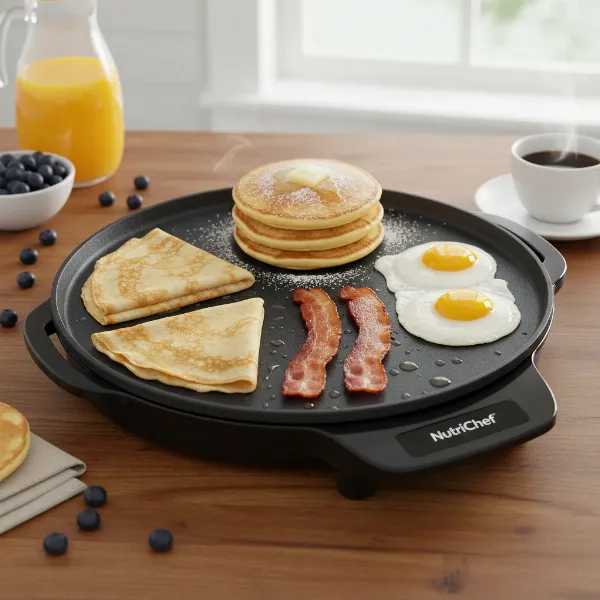
Choosing the right electric skillet can dramatically impact your cooking experience, turning everyday meals into culinary successes. While often overlooked, the shape of your electric skillet—square or round—plays a surprisingly significant role in its versatility, capacity, and overall performance. Have you ever wondered if that perfectly round pancake could be even better in a different pan, or if you could truly fit more food in your skillet? Understanding these distinctions is key to unlocking your electric skillet’s full potential and making an informed choice for your kitchen.
What is an Electric Skillet?
An electric skillet is a versatile, self-contained countertop appliance designed for cooking a wide array of dishes. Unlike traditional skillets that rely on a stovetop burner for heat, an electric skillet plugs directly into an electrical outlet, featuring its own built-in heating element. This design allows for precise and consistent temperature control, often ranging from 175°F to over 400°F, eliminating the hot spots common with conventional stovetops. This consistent heat distribution makes electric skillets ideal for everything from pan-frying and sautéing to deep-frying, simmering, and even baking or roasting.
The history of the electric skillet dates back decades, evolving from basic heating elements to sophisticated appliances with non-stick coatings and advanced temperature probes. These convenient kitchen tools have become a staple for many, valued for their ability to provide an extra cooking surface, maintain specific temperatures, and offer portability for various cooking scenarios, from family dinners to potlucks and even outdoor events.
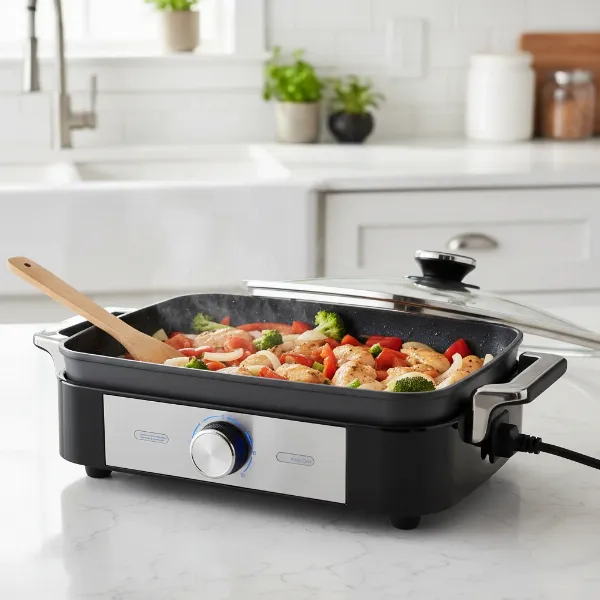 An electric skillet cooking a meal, showcasing its versatility and precise temperature control.
Advantages and Disadvantages of Electric Skillets
Electric skillets offer a host of benefits that make them a valuable addition to any kitchen, but they also come with a few limitations.
Advantages
- Exceptional Temperature Control: Electric skillets excel at maintaining a consistent, precise temperature, which is crucial for delicate tasks like deep-frying doughnuts or achieving perfectly golden pancakes. This control minimizes guesswork and helps prevent burnt or undercooked food.
- Even Heat Distribution: With an integrated heating element, electric skillets distribute heat uniformly across their entire cooking surface, ensuring that food cooks evenly from edge to edge. This is a significant improvement over many stovetop pans that can develop hot spots.
- Versatility and Convenience: These appliances are incredibly versatile, capable of pan-frying, sautéing, simmering, deep-frying, baking, and roasting. Many models feature non-stick surfaces, making both cooking and cleanup a breeze. Some are even dishwasher-safe (after removing the temperature probe).
- Space-Saving and Portable: For kitchens with limited stovetop space, an electric skillet acts as an extra burner. Its portability means you can cook anywhere with an outlet, making it perfect for entertaining, RVs, dorms, or even outdoor cooking.
- Energy Efficiency: Electric skillets often use less energy than a full stovetop or oven, and they don’t heat up your kitchen as much, a welcome feature during warmer months.
|
Our Picks for the Best Electric skillet in 2026
As an Amazon Associate I earn from qualifying purchases.
|
||
| Num | Product | Action |
|---|---|---|
| 1 | Blue Diamond 7QT 5-in-1 Extra Large Electric Skillet, Healthy Ceramic Nonstick Interior, Non-Toxic PFAS-Free, Temperature Control, Stay Cool Handles, Easy Clean, Graphite |

|
| 2 | Elite Gourmet EG808 8” x 8" Non-stick Electric Skillet, Dishwasher Safe with Tempered Glass Vented Lid, Rapid Heat Up, 600W, Black |
|
| 3 | Presto 06857 16-inch Electric Foldaway Skillet, Black |
|
| 4 | Nuwave Medley XL Digital Electric Skillet, Family Size Griddle w/Glass Lid, 2025 New & Improved Precision Heating, 100°-425°F, PFAS Free G11 Nonstick Ceramic Coating, Portable Hot Plate, 7qt Capacity |
|
| 5 | Elite Gourmet EG6201 Extra Deep 12"x12"x3.2" (7.5Qt.) Scratch Resistant Dishwasher Safe, Non-stick Electric Skillet with Glass Vented Lid, Adjustable Temperature, Black |
|
| 6 | Elite Gourmet EG-6203# Extra Deep 16"x13"x3.2" (10.5Qt.) Scratch Resistant, Easy Pour Spout Dishwasher Safe, Non-stick Electric Skillet with Glass Vented Lid, Adjustable Temperature, Black |
|
| 7 | FOHERE 16-Inch Electric Skillet with Glass Cover, 1500W Rapid Heat, Adjustable Temperature, Multi-Purpose Electric Skillet Fried Chicken, Perfect For Family Gathering Cooking |
|
| 8 | Elite Gourmet 12"x12"x2.15” Ceralast™ PFAS Free Ceramic Electric Skillet, Dishwasher Safe, Rapid Heat Up, 1200W, Dark Grey |
|
| 9 | bella Make & Take Electric Skillet, Fits-anywhere™ kitchenware, EverGood™ Ceramic Coating, Adjustable Temperature & Dishwasher-Safe Tempered Glass Lid, Cast Aluminum Base, 1200 Watt, Oatmilk |
|
| 10 | Pioneer Woman 3.5L Electric Skillet, Linen Speckle |
|
Disadvantages
- Requires a Power Source: While portable, an electric skillet is always tethered to an electrical outlet, which can limit placement options compared to a traditional stovetop pan.
- Limited Mobility (while cooking): Once plugged in and cooking, the skillet’s movement is restricted by its cord, which might be less convenient for certain cooking techniques that involve tossing or quick shifting of the pan.
- Not Suitable for All Cooking Methods: While highly versatile, an electric skillet may not fully replace specialized cookware for extremely high-heat searing in cast iron or certain wok-style cooking that benefits from dynamic heat zones.
- Storage Space: Depending on its size, an electric skillet can take up significant cabinet or counter space when not in use.
Common Types of Electric Skillets on the Market
Electric skillets come in various forms, primarily categorized by their shape, material, and specialized features.
By Shape
The shape of an electric skillet is a critical factor influencing its usable cooking area and suitability for different dishes.
- Round Skillets:
Round electric skillets are the traditional shape, closely mimicking conventional frying pans. Their curved edges are excellent for stirring and flipping ingredients with ease, allowing food to glide smoothly without getting stuck in corners. This makes them ideal for tasks like sautéing vegetables, frying eggs, making frittatas, or simmering sauces and stews where liquid movement is important. While visually appealing for dishes like pancakes or omelets, they offer less overall usable cooking surface compared to a square skillet of similar width due to the inherent geometry. - Square Skillets:
Square electric skillets are highly popular for their maximized cooking surface. The straight sides and corners allow for a larger flat area, meaning you can cook more food at once. This is particularly beneficial when preparing multiple pancakes, burgers, or grilled cheese sandwiches simultaneously. Square skillets are also excellent for dishes that benefit from corners for crisping, such as roasted vegetables, casseroles, or baked goods. They efficiently use space, especially when cooking rectangular items like lasagna or a large batch of bacon. However, the corners can sometimes be cooler spots if the heating element is primarily circular, and stirring certain dishes might feel less fluid than in a round pan. - Rectangular Skillets:
Similar to square skillets, rectangular models offer an even larger, extended cooking surface, making them perfect for family-sized meals or cooking long items like fish fillets. They share many of the advantages of square skillets in terms of capacity and suitability for roasting or baking.
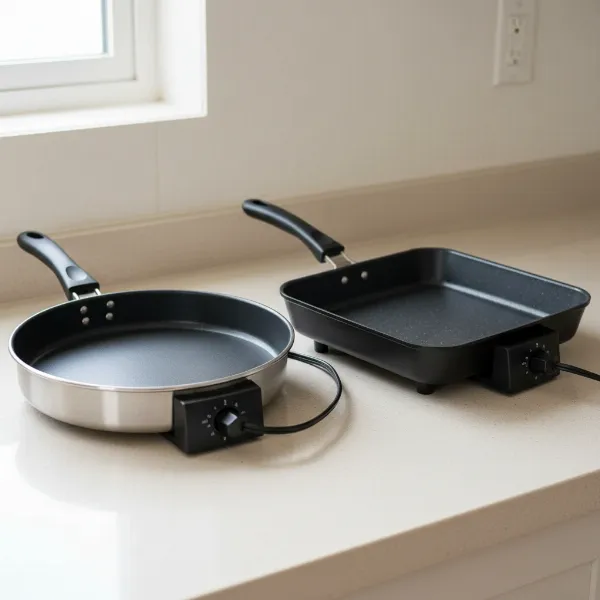 Comparison of a round and a square electric skillet, highlighting shape differences.
By Material
The material of an electric skillet’s cooking surface and body impacts its durability, heat performance, and ease of cleaning.
- Non-stick Skillets (PTFE/PFOA-free): These are the most common, featuring a coating that prevents food from sticking, requiring less oil and making cleanup effortless. Many modern non-stick coatings are PFOA-free and PFAS-free, addressing health concerns.
- Ceramic Non-stick Skillets: Ceramic-based coatings provide excellent non-stick properties and are often marketed as a healthier, more eco-friendly alternative, free from PTFE and PFOA.
- Cast Iron Skillets: Less common for electric models, but some are available. Cast iron offers superior heat retention and distribution, ideal for searing, but requires more maintenance and seasoning.
- Stainless Steel Skillets: While stainless steel is durable and non-reactive, electric skillets with pure stainless steel cooking surfaces are less common due to the popularity of non-stick options for ease of use. They might require more fat to prevent sticking.
By Features
Modern electric skillets come with various features to enhance usability and cooking performance.
- Glass Lids: Tempered glass lids allow you to monitor food without releasing heat and moisture, often featuring a steam vent to prevent condensation buildup.
- Removable Temperature Control: A detachable temperature probe makes the skillet fully immersible for easier cleaning, with clear dial settings for precise heat adjustment.
- Cool-Touch Handles: Ergonomically designed handles that stay cool during operation ensure safe handling and transport.
- Timer Functionality: Some advanced models include a timer for added convenience and precision.
- Foldaway/Compact Designs: Certain models feature collapsible bases or removable handles for more compact storage.
Comparing Popular Electric Skillet Brands
When investing in an electric skillet, brand reputation often correlates with quality, features, and durability. Here’s a comparison of some well-known brands:
| Brand | Key Features | Typical Price Range | Pros | Cons |
|---|---|---|---|---|
| Zojirushi | High-end, precise temperature, deep, often round or rectangular, quality materials | $$$$$ | Excellent build quality, very even heating, durable, some unique features (e.g., magnetic cord) | Expensive, design can be utilitarian |
| Presto | Wide range of sizes (12″ to 16″), often foldaway designs, non-stick | $$ – $$$ | Affordable, good performance for the price, foldaway models save storage space, widely available | Non-ceramic non-stick coatings may not be preferred by all, some lids can be loose |
| Hamilton Beach | Ceramic non-stick, good value, various sizes, straightforward features | $$ | Budget-friendly, good heat distribution for many tasks, easy to clean | May not have the highest durability compared to premium brands |
| Bella | Ceramic Titanium non-stick, durable, quick heating, often 12″x12″ square | $$ | Ultra-durable non-stick, fast heating, versatile for various methods, easy cleanup | Limited feature set compared to high-end models |
| Elite Gourmet | Extra-deep designs, larger capacity, non-stick, sometimes rectangular | $$ | Good for deep-frying and large quantities, often dishwasher safe, robust build | Heat distribution might be slightly less even in very large models |
| GreenLife | Ceramic non-stick (PFAS-free), stylish designs, various sizes (square/round) | $$ | Healthier non-stick coating, aesthetically pleasing, efficient heating, easy to clean | Heat distribution in square models might be slightly less even at corners |
| Nesco | Compact (8-inch), non-stick, basic but reliable | $ | Very compact for small spaces/single servings, affordable, good temperature control | Smaller cooking surface, some users report sticking issues or uneven cooking |
| Oster | DuraCeramic non-stick (PTFE-free), often square, reliable brand | $$ | Durable ceramic coating, good brand reputation for small appliances | Some reports of black ring formation over heating coil (though not affecting function) |
Guide to Choosing an Electric Skillet (Buying Guide)
Selecting the perfect electric skillet involves considering your specific cooking habits and kitchen needs. Here’s a comprehensive guide to help you make the best choice.
Determine Your Usage Needs
Before anything else, think about what you’ll primarily cook.
- Do you often make large family meals, or are you usually cooking for one or two?
- Are you a fan of pancakes, eggs, and breakfast items that require a flat, even surface?
- Do you frequently deep-fry, stew, or braise, needing a deeper pan?
- Will it be a main cooking appliance or an auxiliary one for holidays and parties?
Consider Size and Capacity
Electric skillets range widely in size, typically from 8 inches to 16 inches or more in diameter or side length, with varying depths.
- Capacity: Smaller skillets (8-10 inches) are ideal for single servings or small apartments. Medium (10-12 inches) are good for 2-4 people. Large (14-16 inches or larger) are perfect for families, entertaining, or bulk cooking.
- Shape Matters for Capacity: A 12-inch square skillet offers significantly more usable cooking surface than a 12-inch round skillet. If maximizing surface area for multiple items (like burgers or pancakes) is a priority, a square or rectangular skillet is usually the better choice. For dishes that involve stirring or more liquid, a round skillet might feel more natural.
Choose the Right Material
The cooking surface material affects performance, durability, and health considerations.
- Non-stick Coatings: Most popular for ease of cooking and cleaning. Look for PFOA-free and PFAS-free options, especially ceramic non-stick, for a healthier choice. These coatings are excellent for delicate foods and require less oil.
- Durability: Some brands reinforce their non-stick coatings with titanium or diamonds for increased scratch resistance and longevity.
Check Essential Features
Look for features that enhance usability and convenience.
- Accurate Temperature Control: A removable temperature probe with clear markings and a wide temperature range (175°F to at least 400°F) is essential for versatile cooking.
- Clear Glass Lid: A tempered glass lid allows you to monitor food and helps retain heat and moisture, often with a steam vent.
- Cool-Touch Handles: Important for safety and ease of moving the skillet, especially when serving.
- Easy to Clean: Many skillets are fully immersible once the temperature control is removed, and some are dishwasher safe, making cleanup effortless.
- Stability: A sturdy base prevents wobbling during cooking.
Research Brands and Reviews
Reputable brands often offer better quality, reliability, and customer support.
- Read reviews from other users and consult expert testing sites. Pay attention to feedback regarding heat distribution, durability of the non-stick coating, and ease of cleaning.
- Brands like Zojirushi, Presto, Hamilton Beach, Bella, and GreenLife are frequently recommended for various reasons, from high performance to excellent value.
Compare Prices
Electric skillets vary widely in price.
- Set a budget, but remember that a slightly higher investment can lead to a more durable appliance with better performance and longevity. Balance cost with features and brand reputation.
Tips for Using and Maintaining Your Electric Skillet
To get the most out of your electric skillet and ensure its longevity, proper usage and maintenance are key.
Usage
- First Use Preparation: Before using your new electric skillet, wash the cooking surface and lid with warm, soapy water, rinse thoroughly, and dry completely. Some manufacturers recommend seasoning the pan lightly with a small amount of cooking oil.
- Preheating is Crucial: Always preheat your electric skillet to the desired temperature before adding food. This ensures even cooking and helps achieve a good sear, preventing food from sticking. Use the temperature dial to set the precise heat.
- Adjusting Temperature: The precise temperature control is a major advantage. Start with the recommended temperature for your recipe, then adjust as needed. For frying, consistent medium-high heat is usually best, while simmering requires lower settings.
- Use Appropriate Utensils: To protect non-stick coatings, always use non-metal utensils made of wood, silicone, or heat-resistant plastic. Metal utensils can scratch and damage the surface.
- Avoid Overcrowding: While electric skillets offer ample space, overcrowding can lower the pan’s temperature and steam food instead of browning it. Cook in batches if necessary to maintain consistent heat and achieve desired results.
- Safe Handling: Always use the cool-touch handles when moving the skillet. Be mindful of the hot surface and steam when lifting the lid.
Cleaning and Maintenance
- Clean After Each Use: Allow the skillet to cool completely before cleaning. Promptly clean the skillet after each use to prevent food residue from hardening.
- Easy Cleaning for Non-stick: For non-stick surfaces, simply wipe out food residue with a paper towel, then wash with warm, soapy water and a soft sponge or cloth. Avoid abrasive cleaners or scouring pads that can damage the coating.
- Dishwasher Safe Components: Many electric skillets have removable temperature controls that allow the skillet body and lid to be fully immersed in water or placed in the dishwasher. Always check your model’s instructions for specific cleaning guidelines.
- Proper Storage: Ensure the skillet is completely dry before storing to prevent water spots or mildew. Store it in a cabinet where it won’t be scratched by other cookware. If stacking, place a cloth or paper towel between the skillet and other items to protect the cooking surface.
- Regular Inspection: Periodically check the heating element, power cord, and temperature probe for any signs of wear or damage. If any issues are detected, discontinue use and contact the manufacturer or a qualified technician.
“The electric skillet’s ability to maintain a rock-solid temperature is a game-changer. It’s like having a dedicated heat source that listens to your every command, making it far superior to a stovetop burner for consistent results.” – John Smith, Culinary Instructor.
Conclusion
Choosing between a square and a round electric skillet ultimately comes down to your cooking priorities. If maximizing the usable cooking surface and fitting more food at once is your goal, especially for items like pancakes, burgers, or casseroles, a square or rectangular electric skillet is likely your best bet. Its straight edges provide ample real estate for multiple portions and can lead to more efficient cooking for certain dishes. On the other hand, if you frequently prepare liquid-based dishes, stir-fries, or prefer the fluid motion of tossing ingredients, a round electric skillet with its curved design might offer a more natural and convenient cooking experience.
Both shapes offer the inherent advantages of an electric skillet, including consistent heat control and versatility. By considering your culinary habits and the types of meals you love to create, you can confidently select the electric skillet that will empower you to cook more efficiently and deliciously. Which shape will become the workhorse of your kitchen?
Frequently Asked Questions
Do square electric skillets really cook more food than round ones?
Yes, square electric skillets typically offer a larger usable cooking surface area compared to round skillets of similar diameter, allowing you to cook more food simultaneously, such as a greater number of pancakes or burger patties.
Can I bake in an electric skillet?
Absolutely! Many electric skillets can function much like an oven, especially square or rectangular models. Their consistent, even heat makes them suitable for baking casseroles, brownies, cakes, or even roasting small cuts of meat and vegetables.
Are electric skillets energy efficient?
Electric skillets are generally more energy-efficient than using a full-sized oven or multiple stovetop burners for smaller tasks. They concentrate heat directly to the cooking surface, reducing wasted energy and keeping your kitchen cooler.
How do I clean an electric skillet without damaging the non-stick coating?
Always allow the skillet to cool completely. Most non-stick electric skillets are easily cleaned with warm, soapy water and a soft sponge. Avoid abrasive cleaners or metal utensils to preserve the non-stick surface. Many models allow you to remove the temperature probe, making the pan fully immersible or even dishwasher safe.